What Accusations Did Colonist Make Again King George
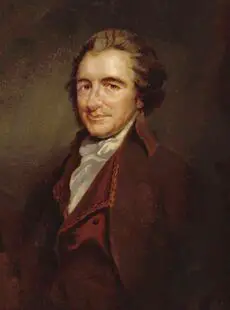
Colonial Americans enjoyed relative independence from England until 1763, which marked the abeyance of the Vii Years' State of war. Prior to that time, the British government had paid little attention to the domestic diplomacy conducted by their American colonists. The war was costly; all the same, and England accounted it appropriate that American colonies contribute to the war debt and the costs associated with stationing British troops on American soil. The British government assessed taxes on the colonies nonetheless denied colonists the right to Parliamentary representation in the House of Eatables.
As a result, Americans saw themselves as being subordinates to the Crown rather than equally equal members of the British Empire, thus prompting the colonists to rebel confronting their mother country in the proper name of liberty. Parliament'due south actions fostered a sense of rebellion amidst the inhabitants of America, while Thomas Paine unleashed a patriotic fervor throughout the colonies that solidified a nation.
Englishmen and Americans alike were filled with British pride post-obit the successful decision of the Vii Years' War. Americans, who were separated both geographically and governmentally from England, felt a renewed sense of kinship with their British brethren. This mental attitude began to alter when Male monarch George Three issued the Proclamation of 1763, which prohibited colonial expansion due west of the Appalachian Mountains. Not accustomed to Crown intervention pertaining to domestic affairs, agitation began to stir amongst rebellious colonists.
Taxes
When Parliament passed the Sugar Deed of 1764, the British pride felt by Americans quickly began to wane.[ane] Although this act did decrease the taxes paid by colonists on imported molasses, the long-established do of smuggling goods in and out of the land, which violated the Navigation Acts of 1651, was no longer viable.[2]The Sugar Human action, along with the simultaneously enacted Revenue Act, was detrimental to coastal merchants. The Revenue Act mandated that wools, hides, and other items that were non previously subjected to the Navigation Acts, were required to pass through England rather than being shipped straight from America to their destinations. This was another even so attempt by King George to attain money from the colonies in order to reduce England's war debt. American citizens, already feeling the pangs of mail-war recession, were feeling their economic security threatened.
The disenchantment with Great britain, which was slowly simmering, reached a fevered pitch in 1765 with the passage of the Stamp Human action; the first direct tax Parliament had levied on the colonies. Whereas all other duties had been paid through trade regulations, this constabulary constituted direct governmental intervention upon a people who had no representation in Parliament. Colonists were of the mind to be dutiful English citizens when they were treated as such. The Stamp Act, which required a stamp purchased through British authorities to be affixed to all printed materials, threatened both the finances and liberties of colonists.[three]While providing the first major split betwixt England and America, the Postage Act concurrently began to unite the colonies equally a nation.
Signs of Unification
Americans surprised London merchants by boycotting English goods while the Postage Human activity was in effect. Colonists banded together, with the urging of such groups similar the Sons of Freedom, and posted numerous broadsides and conducted impromptu meetings in the streets to heighten their fellow citizens' awareness of the oppressive deportment being taken past Parliament. Groups such every bit these began to appear throughout the colonies and politics began to consume the thoughts and conversations not but of colonial leaders but of boilerplate citizens too.
According to historian Eric Foner, "Parliament had inadvertently united America."[4]Rather than seeing themselves as separate entities, the colonies were cooperating instead of competing with one another. In October 1765, the colonies became more unified when the Colonial Congress met to discuss the Stamp Deed in New York. Colonial leaders convened and formally advocated the boycott of British goods. The boycott posed a formidable economical threat to London merchants, who successfully persuaded Parliament to repeal the Stamp Act just i yr afterward its issuance.
Boston
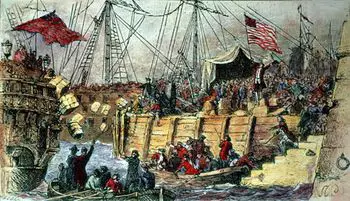
Image depicting the Boston Tea Party, 1773.
On March 5, 1770, the Boston Massacre pushed the colonists closer together and increased the level of dissent against the British beyond the colonies. The Massacre was a confrontation between colonists and British soldiers on the streets of Boston that escalated to violence resulting in the death of five Bostonians by British soldiers. The details of the event were (and still are) blurred and biased, notwithstanding Massachusetts silversmith Paul Revere created an etching that depicted British soldiers executing unarmed Bostonians. This type of propaganda escalated anti-British sentiment, which in turn bolstered colonial pride and the decision to proceeds and hold liberty. The quest for liberty and equal justice was exemplified by the activity of John Adams when he chose to defend the British soldiers involved in the Boston Massacre. Adams held that to fight for justice and equality, all were due to a off-white trial, including the British soldiers. His loyalty to the Patriot cause was well known, thus affording him the ability to emerge from this endeavour unscathed and with his esteemed reputation intact.
With the new taxes imposed and continued Crown intervention, Americans became more ardent in their resolve that they would not become enslaved to a distant government. Freedom was on the minds of patriots while the idea of independence from the British Empire crept into the discussions of colonial leaders. The climactic effect which propelled the concluding split with England came on Dec 16, 1773, when certain colonists engaged in what became to be known every bit the Boston Tea Political party. Sam Adams supposedly instigated the human action of disposing of a shipment of British tea into Boston Harbor; which cost the Crown over ten thousand pounds in revenue. The Tea Act issued before in the year agitated rebellious colonists to the point of destructive and trigger-happy action.
The subsequent reaction from London was to further oppress the colonists through a stringent new fix of laws Americans chosen the Intolerable Acts. King George's wrath was aimed at New England. Thus he closed the port of Boston until bounty was fabricated for the lost tea revenue. Through these acts, boondocks meetings in Massachusetts were stifled; the British government appointed council members in New England and lodged soldiers in individual homes.[five]Outrage swept not only through New England but throughout all American colonies.

Massachusetts delegates met in September 1774 and ended that New England taxes would exist withheld, preparations for war would be fabricated, and obedience to England would exist denied. These resolutions were known equally the Suffolk Resolves. To further reinforce solidarity, leaders of all the colonies, except those from Georgia, met in Philadelphia as the Get-go Continental Congress. The goal of the convention was to coordinate a unified response to the Intolerable Acts[vi] This historic meeting did more than coordinate colonial efforts; the concrete unification of a nation transpired. Virginia orator Patrick Henry all-time described the mental attitude of the nation when he proclaimed, "'I am not a Virginian, but an American.'"[7] Unwittingly, England had united her one time subordinate colonists into a formidable adversary.
Common Sense
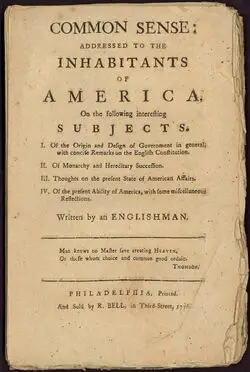
Embrace of the pamphlet, Common Sense.
In an ironic twist, colonists who were once filled with British pride were now consumed with American patriotism. When Americans realized they would never be considered equals with Englishmen, they resolved to find that sense of equality amid themselves; while concurrently denying such liberties to those who were deemed inferior. Such men as John and Samuel Adams, Benjamin Franklin, Thomas Jefferson, and Patrick Henry courageously paved the path to freedom for white men in the colonies. Arguably, the man most instrumental in the movement towards independence, and mayhap the forgotten Founding Begetter, was Thomas Paine.
An Englishman built-in in 1737, Paine arrived in Philadelphia on November 30, 1774, at the urging of Benjamin Franklin. Paine divers the origin of government equally "a style rendered necessary past the inability of moral virtue to govern the world."[eight] He believed governmental representation was a right for every citizen and wrote his pamphlet, Common Sense, in a language accessible to all. Through Paine's words, poor white citizens were able to envision a role in the balloter process and a vocalization in the legislature. For generations, these people were seen equally intellectually inferior to the gentry course and were therefore deemed unworthy of consideration. Although far less educated than the elites, the lower classes were not necessarily less intelligent. Thomas Paine recognized their grasp of politics and understanding of liberty.
Paine's language and call for a new form of government struck a chord with everyday men and invoked a sense of purpose amid small farmers and poor whites. His words instilled ideas in average citizens and brought to calorie-free notions held within this grouping that had lain dormant in their hearts and minds. Public discussions took place amongst commoners regarding politics and social modify. People envisioned a future in which their wishes were considered. The generals and diplomats may have been gentry but the men fighting and dying were ordinary farmers.
Paine's Influence
One reason Common Sense was such an influential slice was considering it was written in a mode understandable by all. Most subsistence farmers of the fourth dimension did not have an instruction conducive to understanding the essence of someone such as philosopher John Locke. Paine used a common language to entreatment to people in all levels of order. By doing so, he discredited the notion that poor farmers and others of the lower classes had no pick only to bide by any law put forth by a distant government. Individually they did not, merely when Paine erased the sense of isolation prevalent throughout the rural communities, he did enlighten those citizens, which in plow elicited their response to revoke tacit consent.
A second reason for the success of Paine'south work is that his words appealed to the overwhelmingly Protestant audience which comprised the citizenship of the colonies. Well aware of his audience, Paine expressly employed biblical rhetoric to convey to the colonists that God is the only king and that it angers Him to be aware of anyone else in His function. Paine selected biblical quotations that signal it is wrong, and even blasphemous to requite a man the championship of "king," which suggests God can be replaced. Past quoting and alluding to scripture early on in his argument, Paine captured his audience. Through his use of history, religion, and sheer logic, Thomas Paine presented a compelling instance that a monarchy is a blasphemous and oppressive form of government from which freedom for the common man could never exist realized. He assured his readers that they were more worthy of God's gifts than a greedy tyrant and that God did indeed create everyone as. This, of grade, is the premise upon which the Declaration of Independence is based.
Paine made a plea to potential patriots by confidently stating that "The nearer whatever government approaches a republic the less business there is for a rex."[nine]Once Paine instilled this thought in the reader; he continued to enhance the fear that without a republic "slavery ensues."[10]This was an specially powerful notion as Parliament was levying taxes at a rapid step and without some class of legislative representation, farmers, trappers, and shippers were sure to have their livelihoods threatened, if not completely eradicated. Information technology tin be argued that the combination of England'south taxation policies and the release of Common Sense, worked in concert to create one cohesive nation rather than 13 loosely joined colonies.
Determination
In the introduction to Common Sense, Paine declares "a long habit of not thinking a thing wrong, gives it a superficial appearance of beingness correct."[xi] This simple sentence opened the minds of common citizens to the possibilities of a less oppressive future in an egalitarian society for white men. Thomas Paine anonymously unleashed the buried patriot spirit of average American colonists. While Parliament was implementing strict taxation laws and occupying the American continent, Thomas Paine was transforming the lives and attitudes of its inhabitants. England created an atmosphere of future subservience among the colonists, while Thomas Paine reached out to these aforementioned people and through his inspired words, fomented a revolution.
References
- ↑ Eric Foner, Give Me Freedom! An American History, second ed., vol. ane (New York: West.West. Norton & Company, 2009), 171.
- ↑ Foner, 83.
- ↑ Foner, 171.
- ↑ Foner, 173.
- ↑ Foner, 180.
- ↑ Foner, 181.
- ↑ Patrick Henry quoted in Foner, 181.
- ↑ Thomas Paine, "Common Sense," 1776, in Mutual Sense, Rights of Man, and Other Essential Writings of Thomas Paine (New York: Signet, 2003), 7.
- ↑ Paine, 20.
- ↑ Paine, 21.
- ↑ Paine,3.
Updated Oct 4, 2019
morrisprilloomply.blogspot.com
Source: https://www.dailyhistory.org/Why_Did_American_Colonists_Become_United_Against_England
0 Response to "What Accusations Did Colonist Make Again King George"
Post a Comment