Can I Carry My Gun From Texas to Louisiana
fourscore years ago on Nov vii, 1940, the Tacoma Narrows Bridge collapsed, and the reverberations of that collapse all the same echo today in engineering, architecture, and physics lectures worldwide.
Connecting Gig Harbor to Tacoma
Built to span a mile-long department of Washington state's Puget Sound, the Tacoma Narrows Bridge was a break-blazon bridge where the deck—or load-bearing role—is hung beneath suspension cables strung between towers.
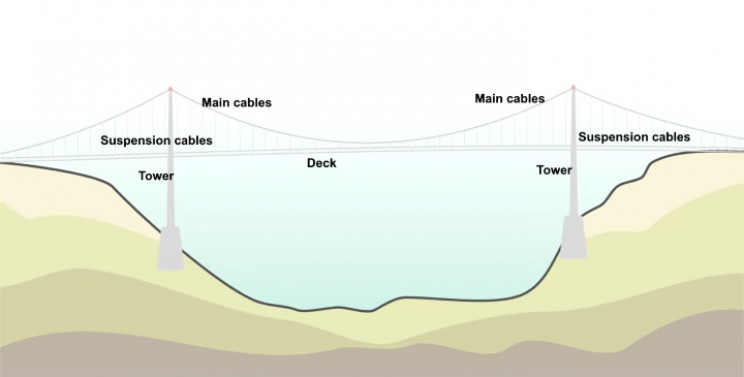
The Tacoma Narrows Bridge was the first bridge that was built with girders made of carbon steel anchored in physical blocks. At the time, it was the world's tertiary-longest intermission bridge, backside just the Gold Gate Bridge connecting San Francisco and Marin County, and the George Washington Span connecting New York City and New Jersey.
Support for edifice the span came from the U.Due south. military, which operated three facilities in the surface area: the Puget Sound Naval Shipyard, McChord Field, and Fort Lewis. Support also came from the Northern Pacific Railway.
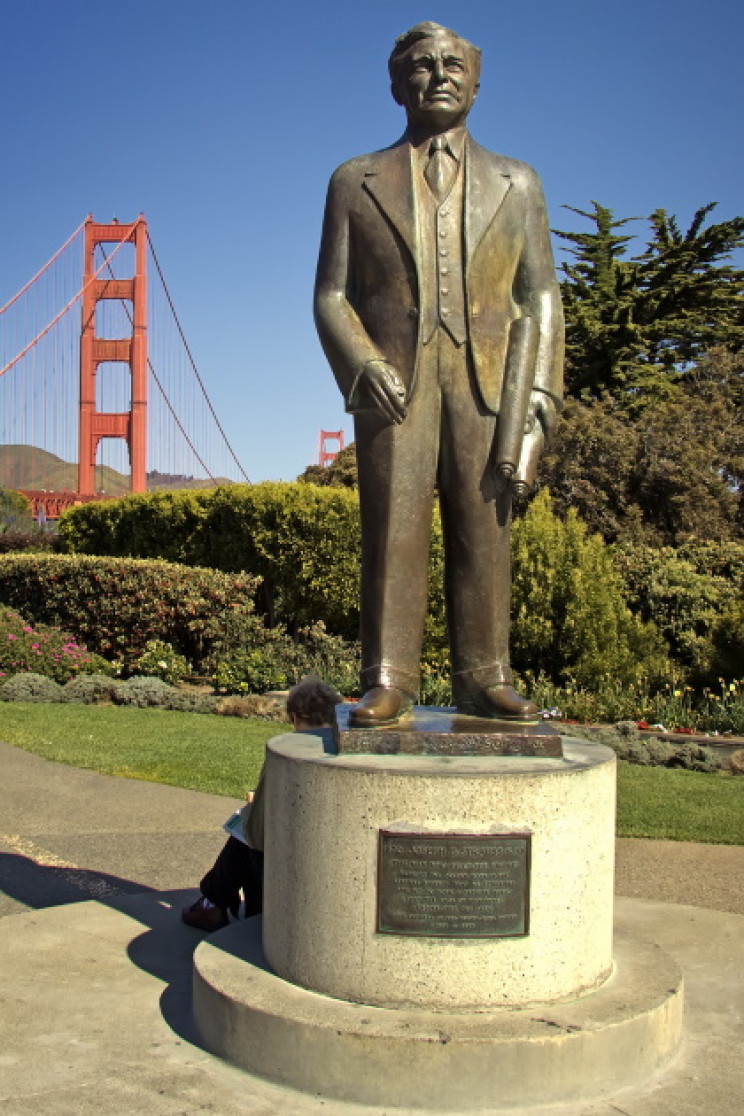
Tacoma's city fathers consulted several notable bridge designers, including Joseph B. Strauss, who had been principal engineer of the Golden Gate Bridge, and David B. Steinman, who went on to design the Mackinac Bridge which connects the Upper and Lower Peninsulas of Michigan land.

Neither Strauss nor Steinman was selected, and instead, a local engineer named Clark Eldridge was chosen. Eldridge proposed a conventional suspension bridge design along with the inclusion of 25-human foot-deep (7.6 m) trusses that would sit below the deck and would stiffen information technology.

A money-saving proposal
However, back in New York, two span engineers, Leon Moisseiff and Frederick Lienhard had only published a paper that described how the stiffness of the main cables would absorb up to 50% of the static wind pressure pushing a suspended construction laterally.
SEE ALSO: 25 EXTREMELY EMBARRASSING ARCHITECTURAL FAILURES
Moisseiff proposed stiffening the bridge with a ready of viii-foot-deep (2.4 m) plate girders instead of the 25-pes-deep (7.6 thou) trusses Eldridge had designed, and this would reduce structure costs considerably. The Tacoma city fathers went with Moisseiff's design, and $6 million (equivalent to $109 million today) was allocated for the bridge's construction.
Construction on the two-lane bridge began in September 1938. At simply 39 anxiety (12 m) wide, the span was quite narrow compared to its length of 5,939 feet (one,810 m), with a main span of two,800 feet (850 m).
As soon as structure workers completed the deck, they noticed that during windy conditions, it would move vertically, and they nicknamed the bridge "Galloping Gertie".
The Tacoma Narrows Span was opened to traffic on July one, 1940, and drivers quickly noticed that the bridge would oscillate vertically up to several feet. Authorities moved to reduce the vertical oscillations by calculation tie-downward cables anchored to 50-ton concrete blocks located on the shore. The tie-down cables snapped inside days.
Next, engineers tried adding cablevision stays connecting the main cables to the bridge deck at mid-span, simply that as well didn't work. Finally, engineers added hydraulic buffers between the towers and the deck that were designed to damp the longitudinal motion of the bridge. These failed when the hydraulic seals were breached when the bridge was sandblasted prior to being painted.
Authorities adjacent hired an engineering professor at the University of Washington to analyze the problem. He and his students built a i:200-scale model of the span on which they conducted wind-tunnel tests. They submitted their conclusions on Nov ii, 1940, and they suggested drilling holes in the lateral girders along the deck to allow the current of air to menses through, and the add-on of fairings or deflector vanes forth the deck to aid its aerodynamic shape.
Neither selection was ever implemented because just five days later on, on November seven, 1940, the Tacoma Narrows Bridge collapsed.
The span comes down
Every bit luck would have information technology, at 11:00 a.m. on that Thursday morn, very few people were on the span. One of the few people on the bridge, Leonard Coatsworth, was an editor for the Tacoma News newspaper and he wrote of his experience of the span coming down:
"Around me, I could hear concrete cracking. I started back to the car to get the dog, only was thrown before I could reach it. The car itself began to slide from side to side on the roadway. I decided the bridge was breaking up and my only hope was to get back to shore. On hands and knees well-nigh of the fourth dimension, I crawled 500 yards (460 yard) or more to the towers ... My jiff was coming in gasps; my knees were raw and bleeding, my hands bruised and swollen from gripping the concrete adjourn ... Towards the final, I risked rise to my feet and running a few yards at a time… Safely back at the toll plaza, I saw the bridge in its final collapse and saw my car plunge into the Narrows."
Sadly, Coatsworth'due south cocker spaniel Tubby was in that car, and he was the just fatality of the disaster.
A subsequent enquiry into the collapse determined that what brought the span down was a twisting motion that occurred when winds reached 40 mph (64 km/h).
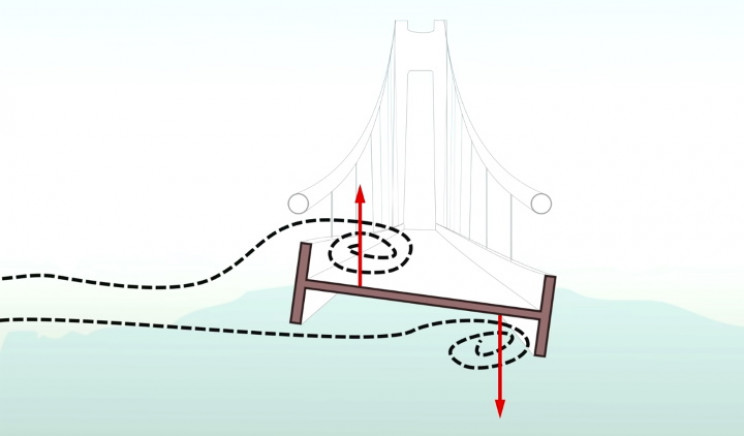
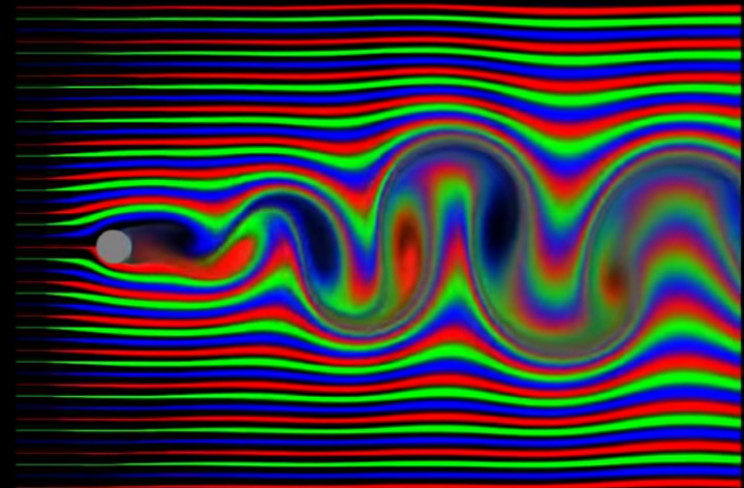
Called a torsional vibration, it caused one side of the roadway to go upwards while the other side went down. The cause of the torsional vibration was something calledvortex shedding. This is where a fluid, or air current, flowing past an object oscillates equally vortices are formed on the behind of the flow. When these alternating zones of low pressure occur at a frequency that is well-nigh to the natural frequency of a construction, even small-scale amounts of current of air can cause major oscillations.
When the aamplitude of the motion increased beyond the strength of some of the suspension cables, they snapped, and the adjacent cables couldn't carry the weight, causing them to snap every bit well.
The collapse of the bridge was recorded by a local camera shop owner named Barney Elliott, and in 1998, Elliott's motion picture titled The Tacoma Narrows Bridge Plummet was selected by the U.S. Library of Congress as being culturally and historically pregnant.
The aftermath of the collapse
When the State of Washington went to collect on its insurance claim for the bridge, they found out that their insurance agent had made off with the premium payment, and that the span was but partially insured.
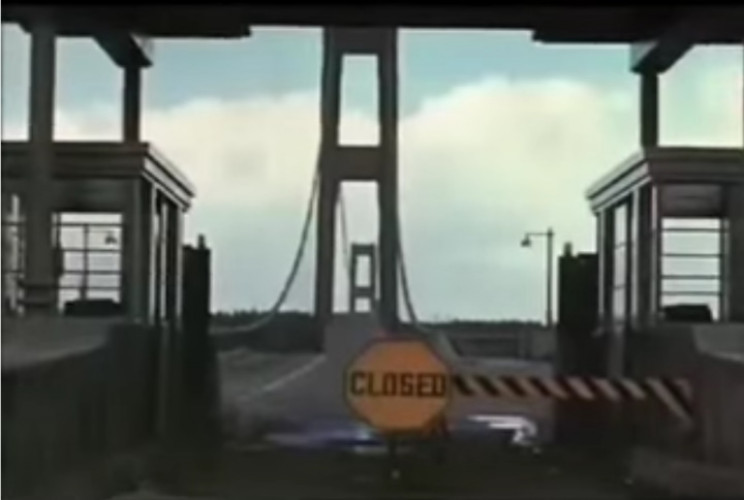
The weather system that caused the Tacoma Narrows Bridge to collapse continued its style across the country, eventually producing the Ceasefire Mean solar day Blizzard on November 12, 1940. Information technology included snowfalls of up to 27 inches (69 cm), winds of betwixt l and 80 mph (80 to 130 km/h), 20-foot (6.one one thousand) snowdrifts, and l° F (28° C) temperature drops in parts of Nebraska, South Dakota, Iowa, Minnesota, Wisconsin, and Michigan.
Record depression pressures were recorded in La Crosse, Wisconsin, and Duluth, Minnesota, and 146 people were killed. Hundreds of duck hunters were stranded on islands in the Mississippi River where they died of the common cold. One survivor was saved by his two Labrador retrievers who sheltered him with their bodies.
In Watkins, Minnesota, the blinding snowfall acquired a passenger train and a freight railroad train to collide, and residents formed a human chain to lead the passengers to prophylactic. On Lake Michigan, 66 sailors died when 3 freighters sank due to the storm.
Today, all over the earth, Barney Elliott'southward film is shown to applied science, architecture, and physics students as a cautionary tale of how the power of Mother Nature needs to be respected.
morrisprilloomply.blogspot.com
Source: https://interestingengineering.com/a-cautionary-tale-the-tacoma-narrows-bridge-collapse
0 Response to "Can I Carry My Gun From Texas to Louisiana"
Post a Comment